
This was one of the biggest trade deadlines in NBA history, but it was also one of the weirdest. Some things happened that made no sense, while other things that should’ve happened didn’t.
I need you guys to help me solve some puzzlers, if you’d please. Consider this an open forum as I talk out loud. Guide me, correct me, supplement my meager offerings. I’ve got smart readers, so let’s hash it out.
A quick table of contents: Why didn’t contenders get better? Why is Kawhi still on the Clippers? Have teams overcorrected on small guards? What can we do about tanking? And just how bad is the Giannis/Kalshi thing?
Let’s dive in with the most pertinent basketball question first.
Why didn’t the contenders get better?
Cleveland pulled off the rare double-victory of adding talent (James Harden/Keon Ellis/Dennis Schroder) and cutting costs. But they were the only strong playoff team of note to add a starting-level player.
Minnesota got a nice bench piece in Ayo Dosunmu. The Knicks and OKC added quality depth guards in Jose Alvarado and Jared McCain, respectively.
That’s the exhaustive (and, frankly, generous) list of teams that provably improved.
You could argue that Boston got better by swapping Anfernee Simons for Nikola Vucevic in a money-motivated move; I wouldn’t. Detroit settled for a “shooter” who is shooting 31% from deep this season and is 0-for-6 from the arc as a Piston so far. Denver and Philly merely got out of the tax (even if I agree with Daryl Morey’s cold assessment that they were selling high). The Raptors and the Lakers shifted around some flotsam. Houston’s GM sat on his hands and wondered aloud if 2026 was “just not our year.”
Instead, all the biggest moves were made by terrible teams who want to stop being terrible next year (not this year! Definitely, definitely not this year). Utah took a woodcutter’s swing with Jaren Jackson Jr., Washington paired Trae Young and Anthony Davis, and Indiana made a big bet on Ivica Zubac (and Tyrese Haliburton’s return to health).
The aprons were too restrictive for some teams, but squads like San Antonio, Detroit, and Houston could’ve made a move with ease. And Cleveland, the only team remaining in the second apron, proved that smart front offices are creative front offices; what’s everyone else’s excuse?
Are teams still that scared of Oklahoma City, which has looked vulnerable while battling injuries to nearly every important player on the team? Did the entire league decide on a whim that money was the only thing that mattered? Were there just not enough sellers out there? Are younger teams like Detroit and San Antonio content to merely experience the postseason, or do they think they already have enough?
Most importantly: Will this be a trend going forward, or is this just a blip?
So many questions, so few answers.
Why is Kawhi still on the Clippers?
LA sent Ivica Zubac away for a Santa Claus-worthy haul. James Harden showed up to work fifty pounds lighter and ten years younger. And yet, Kawhi Leonard, who has arguably been the best player in basketball over the last few weeks, remains in sunny California.
Why?
Yes, the Clippers have no incentive to lose games, given that they owe their draft pick to the Thunder, but that’s a sunk cost. Besides the optics of giving OKC a high pick, that’s not a good reason to avoid jumpstarting a rebuild.
Does Leonard simply have no value until the Aspiration scandal resolves? He should (hopefully!) receive a suspension from the league for his role in securing CBA-shorting endorsements (regardless of how dirty the Clippers are, it’s clear that Leonard and his representation were asking for things they weren’t allowed to ask for).
Teams are undoubtedly still frightened by his health history.
Maybe the Clippers didn’t receive any offers they liked and would rather field a decent team until the fabled summer of ‘27. Perhaps not the decision I’d make, as half the team comes off the books this summer and the other half comes off the next — Darius Garland and depth center Isaiah Jackson are the only players under contract for that 2027-28 season. There might not be enough quality pieces to be competitive even if Kawhi stays healthy (and that’s a big if).
I’m dying to learn what teams offered for Leonard. Even knowing everything we do, the idea of a 2019 Raptors-style run has to have tempted someone. Other front offices kicked the tires, but it doesn’t sound like there was much more action than that.
I wish we had more reporting here.
Have teams overcorrected on small guards?
I’ve been as loud as anyone in discussing the issues that small, offense-first guards have in the playoffs. Increased physicality and laxer rules make it harder for them to generate advantages on stronger defenders, while they are routinely targeted on the other end.
But this trade deadline may have gone too far the other way.
The Bulls are far from the sharpest-negotiating team in the league, but they couldn’t get a single team to pony up a protected first-rounder for Coby White? The Grizzlies were desperate to get rid of Ja Morant and still couldn’t find a taker. Cam Thomas bet on himself with the qualifying offer this year. He became so unloved that not only did nobody trade for him, but his own team waived him. Trae Young had zero value. The 76ers were downright giddy to move off of Jared McCain.
Contracts, injuries, fit, off-court and locker-room issues. There are plenty of reasons to quibble with any individual player. But, to varying degrees, these are still players with definite NBA skills. They might not be as useful as they were once thought to be, but they aren’t useless.
I’m not even saying the league is wrong! It’s just astonishing to me how fast the NBA has turned on the archetype. Has the league overcorrected, or is this simply the start of an even steeper change?
I’m not sure I look forward to an era where the minimal acceptable height is 6’6”.
What to do about tanking?
The tanking this year has been bad and will get worse.
The newfangled form we’re seeing more often is a team playing its best guys for a few quarters and then sitting them in the fourth. That’s how we see rotations like this one from Washington, in which they sat four of their five starters not halfway through the third quarter in favor of Sharife Cooper and Anthony Gill:
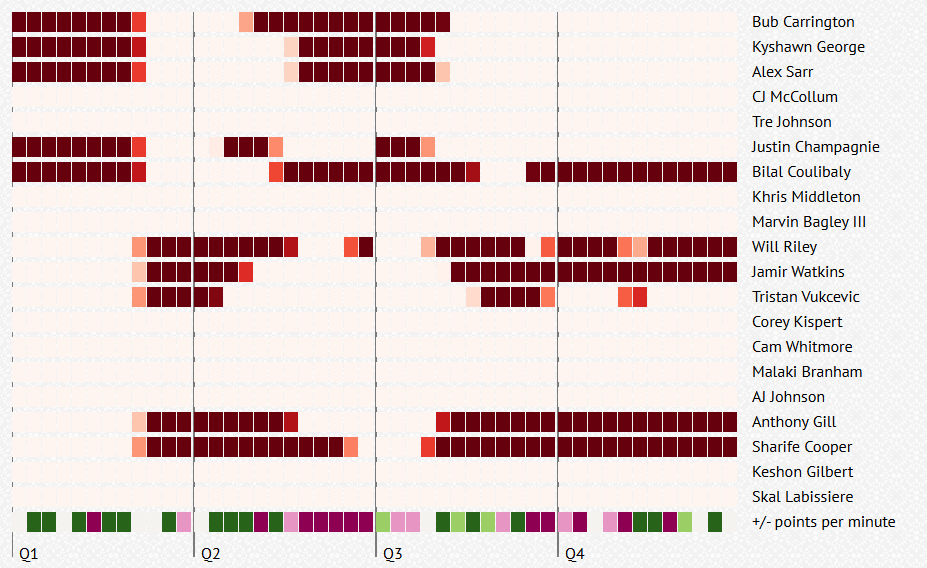
Personally, I kind of like having an extended view of Will Riley and defensive demon Jamir Watkins, but that’s probably not a scalable kind of enjoyment. I get why paying fans would be angry to see their team’s best players benched two-thirds of the way through the game, or not play at all.
That said, I don’t really see a great way to fix tanking. Basketball is the top-heaviest sport in America (although that is changing, bit by bit!). Fans and teams need hope. The only two real fixes I’ve heard are to put in a hard salary cap, remove rookie-scale contracts, and let any team sign any rookie for any amount (as the NWSL does!). That has its own downsides, but at least puts the onus on teams to manage their books and make a hard sell to players rather than lose on purpose. The other is the fabled Wheel, which I find far too predeterministic.
The idea of picking a random cutoff date on the calendar after which accruing wins rather than losses gains you a lottery advantage is popular right now, but that would simply make March better at the expense of November. A minor improvement may still be worth pursuing, but it won’t erase the problem. Same with eliminating fancy pick protections.
(Yes, a relegation/promotion system would be a fantastic solution, but it isn’t remotely feasible. No billionaire wants to buy a team for the GDP of an island nation and then have it demoted to the G-League or NBA Europe or wherever.)
I enjoy all the teams; when I’ve had enough of the Jazz and Wizards trotting out two-way guys, I can simply flip to another, starrier game. There is a distinction here between NBA fans, who have a buffet to watch every night, and team fans, who live and die with their squad. For as much as writers like myself tend to be the former, the latter are the lifeblood of the league! And nobody enjoys watching teams sit their best players.
Tanking is also somewhat seasonal. Next year will feature fewer teams that are hopeless and/or tanking right from the jump and also a much worse draft class. If we have, say, three teams tanking instead of this year’s six or so, there wouldn’t be nearly as much outrage.
Frankly, my biggest issue with tanking is that it leaves the league far more vulnerable to potentially lethal gambling problems. In my opinion, that’s by far the strongest and most important argument for minimizing the Panzer divisions.
Regardless, the league is well aware of the problem, and I suspect they’ll make some token adjustments soon. It’s impossible to see a real fix on the horizon, but as I said, any step in the right direction is worth taking. Just don’t expect a miracle.
Just how bad is the Giannis/Kalshi thing?
Giannis is one of my favorite players ever. I miss the days when he only tweeted about smoothies and how much he wanted to eggplant his wife.
You remember the lead-up to the trade deadline, right? With all its breathless reporting on how Giannis did and didn’t want to be traded, and how the Bucks were and weren’t listening to calls, and how he kinda maybe sort of wanted out but wasn’t gonna say it but definitely did, but also his dad is buried in Milwaukee so maybe he doesn’t?
Well, the dust didn’t need to settle because there was never any movement to stir it up in the first place. Antetokounmpo ultimately stayed in Wisconsin.
That’s fine, in a vacuum. Great, for Milwaukee fans, as long as they’re ready to stomach another six to eight months of trade speculation! The Bucks will undoubtedly receive better trade offers in the summer, when more teams will have more picks to spend. Antetokounmpo might even stay. The idea of the single-team superstar is an iconic one in the NBA for a reason; fans love two-way loyalty.
What’s less fine is coming out as a Kalshi shareholder after weeks of stirring the pot.
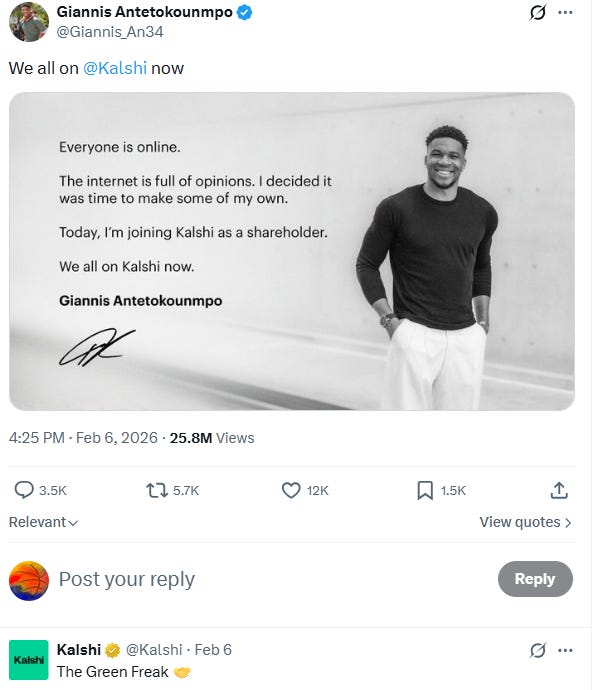
Do we think the Green Freak will stick? For Antetokounmpo’s sake, let’s hope not.
Kalshi, for those unfamiliar, is a massive prediction market (which is legally distinct from a sports betting platform despite eliciting virtually identical responses and behaviors from users). It is regulated, but as an exchange market rather than a sports betting market. There are significant regulatory differences. It doesn’t take sides on a given bet but takes a cut of all action. That both limits its own risk (no bad beats if you don’t choose a side!) and heavily incentivizes betting volume.
Well, there sure was betting volume on whether Giannis would leave Milwaukee. $23 million, in fact.
However bad you think the regulatory oversight and information sharing between sports leagues and their gambling partners have been, they're virtually nonexistent with Kalshi (and Polymarket, a competitor site). Sportsbook monitors caught Terry Rozier; there is no such system in place for prediction markets and the NBA, at least not yet.
I’ll let Bloomberg make it obvious:
At the end of an earnings call in late October, to give one recent example of prediction market shenanigans, Brian Armstrong, chief executive officer of the cryptocurrency exchange Coinbase, decided to rattle off a list of words (“Bitcoin, Ethereum, blockchain, staking and Web3”) because he was told prediction markets were offering contracts on whether he would say them. Although Armstrong later said he didn’t trade on any of his own mentions, such blatant manipulation must be causing angina in league offices, or at least it should be.
That story sure rhymes with the Giannis one, doesn’t it?
Was Antetokounmpo (with help from ESPN’s Shams Charania, who, not for the first time, is adjacent to a major potential gambling story) purposefully manipulating the market, frothing up interest in his final destination, to enrich himself and/or others? I have no idea, and neither do you; that’s the problem.
In Antetokounmpo’s defense: We’ve seen plenty of trade speculation in the past that wasn’t as overtly tied to gambling platforms. Controversy and conversation follow every superstar and are particularly focused on those players A) not on contending teams, and B) in smaller markets. Swirls like this have been a part of the league’s fabric forever; it’s part of the game, literally and figuratively. It’s plausible to think that this was all an unhappy coincidence.
But for Antetokounmpo to make this announcement when it was so obviously going to induce major backlash was incredibly dumb at best and brazen taunting at worst.
(Or maybe it’s not dumb at all. I’ve talked to several previously-blessed people who had never heard of Kalshi before this controversy. Maybe this was quite purposefully timed. Maybe all news is good news for a place like Kalshi.)
NBA players are not allowed to invest in sports betting platforms like FanDuel or DraftKings (though they are certainly allowed to shill for them!). Still, because Kalshi is a “prediction market”, Giannis has not done anything illegal by announcing his ownership. It’s just icky.
From a fan’s point of view, the worst outcome for any team sport is becoming pro wrestling. (Given that WWE seems to be doing just fine financially, I’m not sure the owners would agree.) Eric Mintzer had a nice piece detailing how trust is the only thing separating sports and scripted entertainment. That trust is still there, but every little scandal, every coincidence, every instance of awkward timing erodes it bit by bit.
How long until there’s nothing left?
I’m bummed. Someone tell me why I’m stupid in the comments and make me feel better.
It's not only that we live in a society where more and more people can't distinguish from real and fake (AI, conspiracies, blatant lies), it's that a large segment of the population Does Not Care if it's fake (WWE, reality TV, celebrity endorsements). Giannis is "all in" alrighty. On himself. And always was.
The world doesn’t need more tanking solution ideas from anonymous internet commentators, but why not a completely randomized lottery, 1-14? Ok, this does strongly incentivize ducking the playoffs, so we could just include teams that got eliminated in the first round. All 14 non-playoff teams + 8 teams eliminated in the first round are thrown into a completely randomized lottery, no weighted odds for anyone. This does strongly incentivize throwing the first round series, but I thinking tanking a playoff series is basically unthinkable. Even if you disagree, the idea is probably still directionally correct, just tweak it. (Of course I’m probably missing some massive obvious flaw)