
The 13 most and least consistent stars of the 2026 NBA season
Why inconsistency ain't always a bad thing, plus the small guards' revenge!
This is now the fifth year in a row that I’ve recorded the NBA’s most and least consistent stars. Historically, it’s been one of my more popular summer articles, so if you all keep reading it, I’ll keep writing it!
If you’ve been around for a while (thank you!), some of the following paragraphs will sound familiar, so feel free to skip to the good stuff. If you’re new or need a refresher, however, stay right here.
There are many ways you could define consistency. For ease of comprehension, I leaned on John Hollinger’s old Game Score metric1 for this analysis. Game Score is a game-level (duh), all-in-one metric that tabulates a player’s box score contributions. It roughly scales with point totals, so Game Scores of 30+ are great and Game Scores of <10 are terrible (by this group’s standards, anyway).
I limited the population just to the league’s top 50 qualifying scorers, since points are the primary driver of Game Score. Feel free to plow past the following italicized paragraph if you don’t care for the nitty-gritty methodology.
Boring math: I took every NBA player’s stats from every game last season and whittled it down to the top 50 point-scorers in the NBA, min. 41 games played. I excluded games of <20 mins played to remove injury-truncated performances. I then adjusted Game Scores to a per-36-minute number, took the standard deviations of each player’s adjusted Game Scores, and normalized them by dividing the standard deviation by the player’s mean Game Score per 36; this helps stabilize comparisons between players whose average Game Score is 15 and those whose average Game Score is 25.
It’s important to note that the standard deviation divided by the average doesn’t mean anything tangible in and of itself, but it is useful for rank-ordering players. A lower number indicates more consistent output; a higher one indicates greater nightly variance.
Now, let’s look at the league’s least consistent stars! As I typically do, I’ll also include a scatterplot with all 50 players at the bottom for paid subscribers.
The 13 least consistent NBA stars of the 2026 season
I want to caution against using inconsistency as a pejorative, at least as we’re framing it here. The bottom of these rankings is riddled with perimeter players who rely upon the high-variance, low-accuracy three-point shot. Shooters have a vital role in a functioning NBA offense, even on off nights; do defenses leave Steph Curry open to double-team Draymond Green even when Curry is 2-for-11 from deep? Of course not. Game Score is a box score metric, so it can’t account for on/off data or anything more complex. Therefore, floor spacers are unfairly penalized by this analysis.
Typically, lower-scoring players are at the bottom of this list, too, as they’re more likely to be relatively volatile from one night to the next than the unquestioned alpha dogs.
Still, there are always interesting players at the top and bottom of this list. Here’s the latter:
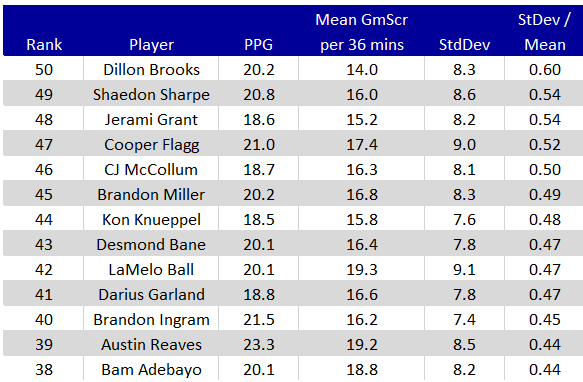
We see several small guards like CJ McCollum (congrats on the new deal!) and Darius Garland, but there are still some fun quirks.
For example, all three of the Hornets’ ballhandlers are here! LaMelo Ball, Brandon Miller, and Kon Knueppel are all eager bombers from deep. It’s a credit to the Hornets’ ecosystem that when one guy had it going, the other two were happy to feed the hot hand. I suspect Knueppel would’ve ranked much higher for the first two-thirds of the season before he hit the rookie wall — his two least efficient months shooting the ball were March and April.
Cooper Flagg’s presence reflects how his efficacy waxed and waned throughout the season. He was always a force, but having to play point guard for the first part of the season (and then again at the end) and being the focal point of every defense’s attention as an 18-year-old made for a roller coaster box-score season. I don’t expect him to linger at the bottom for long.
I’m a little surprised Austin Reaves is here, as his ability to earn free throws should be a steadying force. But he’s somewhat a victim of having too high of highs, as he memorably dropped a number of 40+ scoring performances in the absence of Luka Doncic and/or LeBron James early in the season. His ceiling significantly receded when the team was healthy.
Speaking of too-high highs, Bam Adebayo’s 83-point game represented the highest raw game score of the season (60.5, in case you’re wondering). Adebayo may have been here anyway, as his dramatic increase in three-point volume meant his stats swung wildly from one night to the next. Big men who aren’t uber-efficient rarely fare well in this exercise (in fact, Alperen Sengun was just one spot ahead of Adebayo).
Big men who are efficient and prolific? We’ll see a few of them with one more swipe-to-scroll.
The 13 most consistent NBA stars of the 2026 season
Your most consistent NBA players are often the MVP candidates, but there are always a few unexpected names in the mix. This year, there were more than a few! Behold: