

Come with me. Buckle in. I want to test-drive a take like it’s a used minivan, and I need someone to ride shotgun. Make sure the seats are comfy; help me navigate.
In case you haven’t heard, the NBA presented a new proposal to fix tanking the other day. People hate it.
But what if the NBA lottery reform is fine? What if it’s actually — gasp — good? I’m sorry, but I did tell you to strap in your seatbelts.
The new rules are a little complicated at first glance1, so let Sportico’s Lev Akabas simplify things for us:
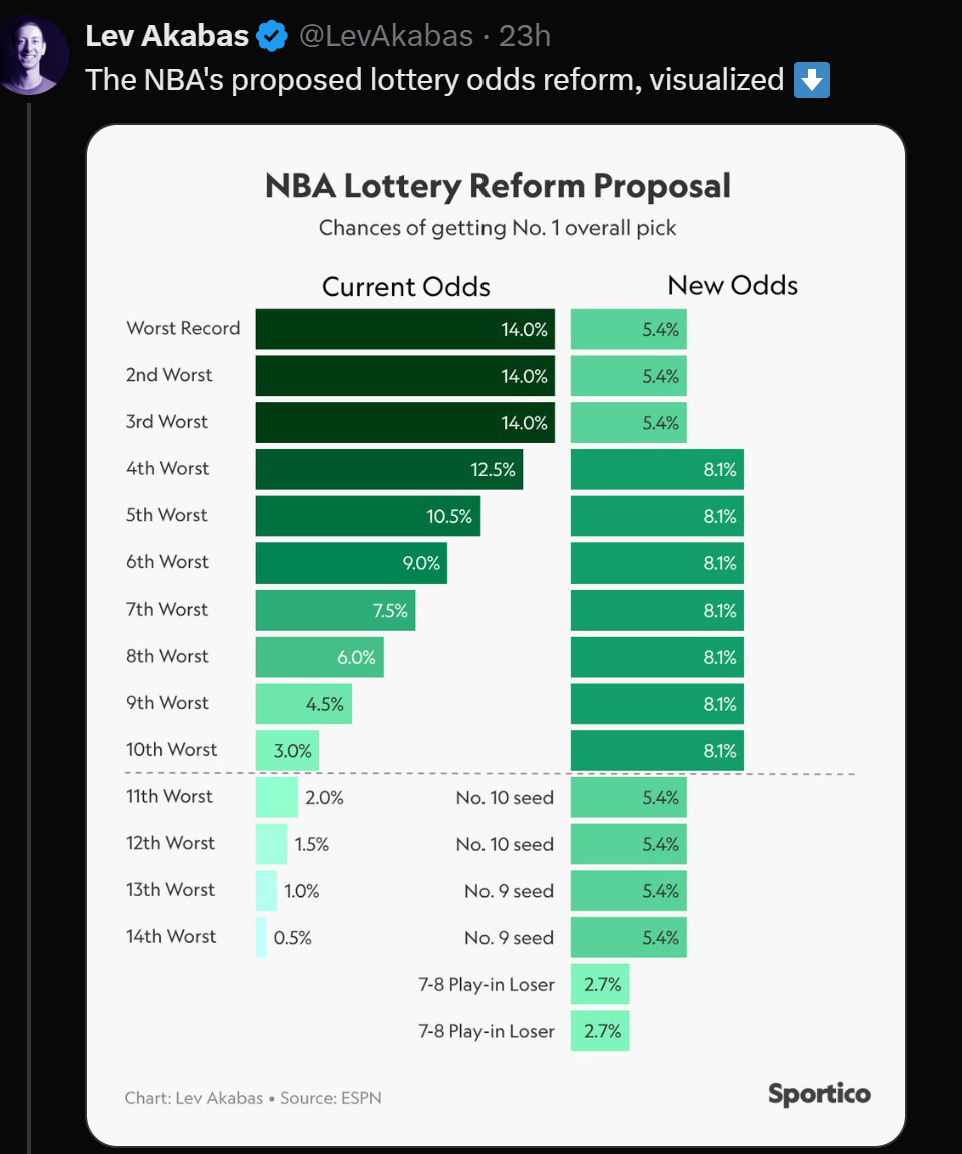
Basically, the odds are flat for most of the lottery teams. Notice that the worst teams actually get slightly shorter odds, the so-called “relegation zone,” and a few of the play-in teams will get new odds, too.
Other important rules: No team can get the #1 pick two years in a row; no team can get a top-five selection three years in a row; the worst team’s floor is the 12th pick, while everyone else could fall as far as #16; and the league reserves the right to punish teams they deem to be tankers by changing draft odds for the offending teams.
Also, the reforms will sunset after the 2029 draft, allowing changes or modifications before renewal. There’s an exit clause built in.
Many of the same fans and media members who lambasted the NBA for this year’s widespread tanking have also lambasted this proposed solution2. I find that curious, given that it directly addresses the problem — and might have some unintended benefits, not just unintended drawbacks.
Let’s start with a few basic ideas. Completely decoupling record from draft position is a bridge too far for the league right now. Any system that ties win/loss record to draft position is prone to some sort of manipulation. There will always be ways to game the system.
The first obvious question: Will some team try to tank out of the play-in games (or down into the second game, to have their cake and eat it, too)? Maybe. We’ve already seen teams do that, notably the Dallas Mavericks after Luka Doncic was hurt back in 2023, but I don’t really buy it becoming a widespread crisis.
Few owners will be willing to forego potential playoff revenue for slightly increased odds at a better draft pick. Think of the 8-seed Heat making the NBA Finals a few years ago, or this year’s Magic team coming out and taking a commanding lead over the Pistons. Miracles can only happen if you allow them to.
Some teams will try to drop to 9/10 or lose the first play-in game anyway, but the league will be watching carefully. They’ll undoubtedly threaten to change draft odds for the most blatant tomfoolery. (I’m doubtful the league would ever actually do that, but perhaps the threat is enough.) And teams also cannot protect picks in the 12th-15th slots going forward, minimizing some weird protected-pick nonsense.
Regardless, we might see one or two process-oriented GMs lose a couple of games down the stretch on purpose. Which is way, way fewer than what we see today, when we had nine separate teams tanking dozens of games!
Adam Silver said a very basic truth: “We should have a system where you should hate to lose. It shouldn’t be a badge of honor to lose. Losing should be uncomfortable.” Undeniably, this system will result in more teams attempting to win more games. The cumulative on-court product will be better, period.
The more legitimate complaint I hear about this system is that it punishes bad teams for being bad. Some decent teams will be getting good picks, while some terrible teams — perhaps most terrible teams! — will get worse picks. They might get worse picks for a long while.
My question: Are we sure that’s a problem? It certainly goes against American sports precedent and this idea we have of “fairness,” but how fair is it that teams that try to win today are punished? How fair is it that the current system incentivizes losing, makes losing the best choice for a third of the league? Not much of a system, if you ask me.
Right now, the worst place to be is in the middle. Teams know that, leading to an increasing barbell distribution in team quality. The dirty secret of the NBA is that it’s not hard to be competitive (not now, at least; we’ll see how much harder it becomes). It’s very hard to be great, but it’s pretty easy for a team to win 33 games.
This system could well end with decent teams like this year’s Orlando Magic or Miami Heat or Phoenix Suns getting a top-five pick, perhaps even the first pick, while the Washington Wizards or Sacramento Kings of the world end up picking 15th.
That’s a surface-level bummer, but shouldn’t we want to reward try-hard teams for, you know, trying hard? It would make for an even more thrilling lottery. Instead of sending the next Victor Wembanyama to some no-hope franchise that will need years to surround them with a winning cast, he could land with a team with a real infrastructure, a real culture, and a real path to winning tomorrow. Not, like, three seasons from now, if things break right and they get lucky while tanking for a few more years. Better players will be placed in better environments sooner.
Are we sad that the Spurs won 34 games last season, only for Lady Luck to hand them the second pick and Dylan Harper? (Sure, San Antonio tanked to get Wembanyama, but this is illustrative. He would’ve gone somewhere, and a similar situation would’ve played out.) Harper has been an instrumental part of the only team in the league that gave the Thunder a real fight in the regular season. We should want more of that, and we’d get more in this new system.
Middling teams can keep trying to improve without blowing it up or trading the whole kitchen for a past-their-prime superstar. More trampolines will be available to jump them from feisty to great. The playoff landscape could wildly change overnight. I’m excited for that!3
And the race to avoid the relegation zone will make for some late-season drama even for non-playoff teams. Imagine some of these double-tank games from last year if both teams were desperate to win instead of lose.
It might be harder for bad teams to get better, faster, but that doesn’t mean they can’t improve. Instead of some team like the Utah Jazz sitting or trading everyone with a pulse by February for three straight years (only to suffer poor lottery luck anyway), they can fully unleash Will Hardy to coach his ass off (and man, Hardy must be chomping at the bit).4 They can invest in their analytics and performance staff. They can find diamonds in the rough and work on polishing them, instead of disposing of the half-finished rocks at the nearest convenient thrift shop for pennies.
Tanking teams were happy to skimp on the margins. No more. Now, the worst we might see is an attempt at a controlled ascent, rather than a terminal-velocity plunge.
Heck, the NBA might even consider changing future CBAs to encourage other means of acquiring superstars, like via free agency. Imagine that!
One more fun thing I haven’t seen anyone else discuss: This could have a major impact on the trade market. More teams will suddenly have access to picks with a higher expected value. Does that mean that acquiring a super-duper star like Mikal Bridges only costs, say, three first-round picks instead of five? (Sorry, Knicks fans, but you were riding way too high after last night’s ghastly, unhinged beatdown of the Hawks.) If the asking price for stars is one or two fewer firsts, more teams will have the ability to make those trades. More potential trade partners should lead to more movement (although, to be fair, it’s almost impossible to imagine a frothier trade market than we’ve seen in the last few years).
Yes, there will be casualties. Some team, perhaps teams, will have a bottom-three record and miss out on a top-10 pick. It might happen again. Harden your hearts, and prepare to suffer.
But you know what? I’m ready and willing to sacrifice a few lambs. You know how I feel about sheep. If one or two teams are collateral damage for a few years, but the league is objectively more enjoyable for the other 28 squads, that’s a price that I’m willing to pay. I want avenues for decent teams to become great at least as much as I want avenues for bad teams to become decent. We need more titans duking it out in the clouds, not more bottom-feeders scrabbling in the mud.
No system is perfect, and better (albeit more dramatic) ideas exist. I do have a few qualms with this one. Perhaps there should’ve been a bridge year to allow teams to reposition accordingly. I do think the floor of 12th for the worst record is a bit too punitive (can we make it, like, eighth?), but that’s a small problem whose fix might result in the exact kind of tanking this aims to eliminate. And, yeah, I’m worried that OKC will swashbuckle into the first overall pick in the next few years (which they might have anyway).
So I understand why a lot of smart people think this is a dumb idea. The Interwebs are a bloodbath. And yet, there’s a good chance this reform will work reasonably well.
How was the test drive? This is just a lease. If you haven’t made up your mind, don’t worry. In 2029, we can decide whether to purchase the van permanently.
Right now, though, I’m kinda liking the way it feels.
I’ve seen a few people complain that it’s all too complicated for fans. That’s a dumb argument. The current system is too complicated. Does anyone know the exact percentage that the eighth-worst record gets today off the dome? No, they just go and look it up online when they want to. They’ll do the same with this. It’s fine, I promise. Nobody will stop watching the NBA because they don’t get the new lottery rules.
I am on record as not caring about tanking whatsoever. This has been an exceptionally bad year for a cocktail of reasons that are unlikely to be replicated in the near future, and I doubt we’d see anything like this in 2027 or 2028. But the discourse around purposeful losing had grown so loud, so overpowering, that it had become one of the only things the “casual” NBA fan heard about this season. I understand why the league wanted to change the optics, even if the need for change was overstated.
One risk we have to stomach: This arguably makes OKC even better equipped going forward. The Thunder already own a million first-round picks, and those picks just became potentially more valuable. Still, there was no real option available that wouldn’t help them to some degree.
Utah was already poised to stop tanking next season since they don’t own their own draft pick anyway, but let me use them as an example, please.
I like that it adds value to players like DeRozan, Sabonis, Brandon Ingram, etc. who can get a team from 25 wins to 35 wins but aren't fit for championship contenders. We should care at least a little about those players!
Which I think would juice the trade market in another way: differential value of players between teams. The Bulls have already been acting like being the 12-8 seed was a worthy goal. That's why they traded a great role player (Caruso) for a subpar offensive engine (Giddey). That was a good trade for the league! The Bulls and the Thunder got better and more interesting to watch.
Personally, I’m much more anti-tanking than you. I think every team should be desperate to win every season, and that this is fundamental to the integrity of the sport.
I think draft reform is necessary but only half the puzzle. I think the ‘championship or bust’ mindset has gone too far. I wish there was more honor associated with being a playoff team, and more dishonor associated with stinking. I guess I’m just yelling at the clouds though.