
The lead-up to the season is my favorite run of articles, even if the sheer number of words I’m pumping out has me icing my fingers every night.
Unlikely-but-plausible predictions are distinct from your average “hot take,” a phrase I loathe. I put a lot of thought into these, trying to get ahead of the curve. I aim for roughly a 25% hit rate; much higher, and I wasn’t bold enough, but much lower means I wasn’t realistic. I even go back and grade them in the summer!
Really, these predictions are simply a view into the players and teams I’ll be watching closely this season. Let’s begin.
And hey! Before I forget, I talked about “Identity Changers” — players and coaches who will upend the way their new teams play — on RealGM Radio. Listen to the pod (YouTube, Spotify, Apple Pods) for crispy notes on more than a dozen guys, from LaMelo Ball to Isaiah Joe to LeBron James to Chip Engelland.
1) Leaguewide offensive rebounding hits 30%
Damn the torpedoes, we’re running it back!
For the fourth year in a row, I’ll make this prediction. Last year, teams got so close — 29.0%.
The league has seemingly figured out how to crash the glass without sacrificing transition defense, for several reasons:
Tactically, the prevalence of tagging up1 and allowing corner spacers to linger by the free-throw line after a shot
Replacing several old-school coaches over the years with younger, more analytically inclined ones focused on the possession game
The prevalence of three-point shots, which take longer bounces and provide more opportunities for offensive rebounders
A slight transition away from small-ball and toward more traditional two-big lineups
Many of last year's best offensive rebounding teams were also decent-to-good at transition defense:
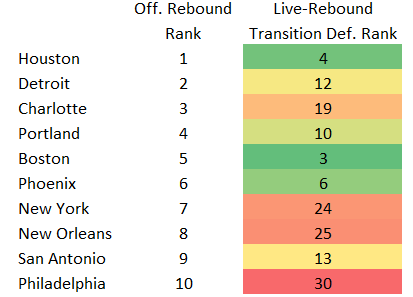
The 10 best offensive rebounding teams averaged 15th in live-rebound transition defense; exactly average. For every New Orleans and Philadelphia (and my god, is Philly’s transition defense going to be bad this year) pantsing themselves running back, a Houston or Boston was crushing it on both ends.
More offensive rebounding is fun, so here’s hoping it finally cracks that mythical 30% barrier it hasn’t reached since 2004-05. Mostly, I just want to stop writing about it.
2) Scoot Henderson gets traded midseason
I almost never predict trades, but I’ve already talked about my hopes for a Lillard Sixth Man of the Year campaign, and I wanted to talk more Blazers. So here we are.
Ja Morant, Damian Lillard, Deni Avdija, and Jrue Holiday are all ahead of Scoot Henderson not just in the offensive pecking order, but as general ballhandlers, too. The former third overall pick isn't exactly in a position to succeed in Portland.
Health and lack of opportunity have kept Henderson from showing what he can really do as a starter, but he’s improved every year. The shooting isn’t knockdown, but it’s steady. His defense is on the ups, but the final level is uncertain. His passing has always been there when he’s given the keys to the offense. Scoot still can’t really finish at the rim, but he’ll improve if and when he stays upright for an extended period. On any given night, he’ll show a fine piece of his game, but he rarely puts all his best feet forward at once.
I have no idea what to make of him, and I’m not sure the Blazers do, either.
Henderson will be entering the final year of his rookie deal. He desires a big new contract, but it’s doubtful Portland will meet his wants. Restricted free agency has become rather unkind to players like Henderson; if I were him and his representation, I’d work the phones hard to see if anyone would offer Henderson a lucrative extension while meeting the Blazers’ price for a trade.
That’s a lot to ask, and we don’t usually see highly-drafted players get traded on their rookie-scale contra — oh wait, the #1 overall pick from two years ago, Zaccharie Risacher, just got moved this summer. Never mind.
Holiday and Lillard don’t have too many years left as high-level contributors; Ja Morant is his own kind of question mark. Portland likely would love to hold onto Henderson for a succession plan, and holding his rights ensures they can. But if he makes enough noise behind the scenes, and someone else comes calling in pre-agency for Scoot… I wouldn’t be shocked to see him elsewhere in February.
3) Austin Reaves and Cooper Flagg both make the All-Star team
Neither Reaves nor Flagg felt bold enough on their own, so I decided to ramp up the difficulty and parley them.
Health could be the only thing standing between Reaves and a surefire spot. In 12 games with Luka Doncic and without LeBron James, Reaves averaged 25/5/7 on excellent 63% true shooting. If he’s doing that for the first half of next season, the numbers will be too big to ignore.
Flagg snatched a Rookie of the Year trophy by averaging 21/7/5 himself (with generous rounding), albeit not as efficiently as Reaves. But Kyrie Irving will make things easier, and it’s fair to expect monster growth from a player who's somehow still one of the youngest in the league (even accounting for all the new rookies).
Flagg was already a good finisher and playmaker as a rookie; how much better can he be? The spacing on this team is still cramped, and an injury to Irving would be nearly as devastating to Flagg as Irving himself. Even after a little bit of a talent drain, the West is still loaded with big names.
This is a bet on the sheer talent involved. As in his lone year at Duke, Flagg visibly improved as the season went on. There’s little reason to think he won’t make a kangaroo-sized leap this year.
4) Philadelphia leads the league in free throw rate
Free throw rate, as defined by Cleaning the Glass, is made free throws per 100 possessions. So it’s combining quantity and quality.
The 76ers were sixth in this stat last year and added LeBron James and Jaylen Brown. While James isn’t at his peak in this regard, both he and Brown still use their strength to knock defenders off balance and get to the charity stripe. Brown shot a career-high 79.5% from the free-throw line last season.
If Joel Embiid, perhaps the premier practitioner of dark foul-drawing sorceries, cracks 40 games for the first time since 2022-23, this will be a lock.
5) Meleek Thomas makes an All-Rookie Team
Meleek Thomas, a 6’3” shooting guard who sports some adorable braces in his NBA headshot, was Summer League’s surprise leading scorer, averaging 27.3 points per contest for Cleveland. The second-round pick received a long look in last night’s preseason game, too, and while he wasn’t quite as electric (11 points on 5-for-13 shooting in a game-high 23 minutes), he’s got the kind of silky self-creation that the occasionally stodgy Cavaliers have desperately needed:
![fab8r4_1.mp4 [video-to-gif output image]](https://substackcdn.com/image/fetch/$s_!voam!,f_auto,q_auto:good,fl_progressive:steep/https%3A%2F%2Fsubstack-post-media.s3.amazonaws.com%2Fpublic%2Fimages%2Fc5eaa2c3-e75f-4692-be11-a23d174f2c34_796x414.gif "fab8r4_1.mp4 [video-to-gif output image]")
The Cavs are deep, particularly if boomerang Mario Hezonja can actually play (he, too, received plenty of minutes in the first preseason game). But something about Thomas’s heat-check confidence tickles me, and he’s got enough defensive and passing chops to pique my interest.
He has the talent to be a top-10 rookie this season; will he get the opportunity?
6) The Clippers, not the Kings, enter the relegation zone
The poorly-named “relegation zone” was part of the league’s lottery reform. It ensures the bottom three teams all have worse odds of getting a top pick, hoping to scare a minimum of competency into the league’s dregs.
That line of logic doesn’t really work for bad teams that don’t control their own picks, however. I’m taking it as a borderline fait accompli that the Brooklyn Nets and Milwaukee Bucks will be two of the three worst teams next season. The Rockets have swap rights with Brooklyn (thanks, James Harden!), and the Pelicans or Hawks get the Bucks pick (from the long-ago Jrue Holiday acquisition which led to a Bucks championship).
The Nets and Bucks won’t be incentivized to lose, but they won't be chasing wins, either.
The Kings, on the other hand, are the overwhelming Vegas favorite to post the league’s worst record. Their 21.5 over/under is three wins worse than Brooklyn’s 24.5, the next-worst projection. That’s crazy!
I get it, from a this-is-the-Kangz-we’re-talking-about-here perspective. The roster does not overfloweth with talent. All the vets seem unhappy, and the franchise’s fate rests on a rookie point guard — traditionally a losing proposition.
But Sacramento does control their own draft pick. They will be scratching and clawing like a cornered ‘coon to get out of the dreaded relegation zone. Logic dictates that sheer desperation (which may or may not include a moderate win-now trade at the deadline) should be enough to float them past another team that doesn’t control their own pick. But who would that be?
Oh.
Sorry, LAC fans. Note that these are unlikely predictions, because I think this is closer to a play-in roster with a little scrappy upside. But injuries keep mounting, and without a pick to care about, Los Angeles should ask anyone and everyone if they want useful vets like Derrick Jones Jr., Kris Dunn, and more. I don’t know if the fire-sale route would be worthwhile versus simply putting out a decent product, particularly for a team with a, uh, fragile relationship with its beleaguered fans. But it’s a real possibility.
Danny LeRoux of The Athletic and Dunc’d On likes to talk about the gravity of incentives. In this case, I think the Kings wanting so badly to win a few games and the Clippers not particularly caring could be enough to flip the script.
7) At least as many teams are between 30-39 wins as between 40-49 wins.
This is my stab at discussing how increased competitiveness around the league could affect win distributions. I’m hopeful that the barbell distribution days, when two handfuls of gawdawful teams gave free wins to everyone else, are over, and we’ll see a much more linear stratification of wins. More squads than usual will wind up in that 30-40 win zone, and far fewer will reach 45+.
Under the old lottery system, there was no reason to aim for 35 wins. If you were going to be bad, you wanted to be really bad. That meant any team with a shred of talent/dignity could eat wins from the league’s flounders and catfish.
Last season, an incredible 10 teams were between 40 and 49 wins, versus three between 30 and 39. That’s a starker split than usual, but you have to go back to 2018-19 for the last time the 30s were equally represented.
I’m not exactly sure how this will all play out, but the lottery reform will change things. We’ll discuss that more further down.
LAST CALL to take advantage of Basketball Poetry’s 25% off sale. This $30 steal-of-a-deal ends TONIGHT (or sooner, depending on your time zone!).
Unlock the rest of this article, my signature “surprising skills” pieces, the definitive League Pass rankings, all my super-comprehensive and extra-speedy trade grades, and tons more!
Look, I’m already the cheapest Substack around (and these words are all 100% human-written!). If you like reading Basketball Poetry and want to keep it free of obnoxious gambling ads, please support it and me with a paid subscription. Last chance for a long time!